- Pengarang: Abida Din
Finding the right custom plush toy manufacturer is an important decision for any business. The best factory is not always the affordable option.This is a complete research guide. It explores custom plush toy manufacturers around the global platforms and explains how brands, artists, startups, retailers and organizations can choose the right factory for their needs.
Global Country By Country Analysis
| Country / Region | Key Advantages | Potential Disadvantages | Best Suited For |
| Cina | Large and well-developed supply chain; strong manufacturing capacity; wide range of materials, components, and manufacturing capabilities | International shipping and longer lead times for some markets; trade policy and tariff considerations; factory capabilities and quality can vary | Startups, Amazon sellers, private-label brands, well-known brands, large retailers, and complex custom plush products |
| Vietnam | Low labor costs; a trade agreement with the U.S.; favorable tariff advantages | Less-developed supply chain systems; many raw materials and components need to be imported from China, resulting in longer lead times; relatively low manufacturing complexity | Mid-volume brands, private-label brands, and businesses seeking supply-chain diversification |
| Indonesia | Low labor costs; a large labor pool; some experience in textile and apparel exports | Limited specialization in plush toy manufacturing; infrastructure and logistics challenges; inconsistent quality; dependence on imported materials and components | Large-scale, relatively simple plush toy projects |
| India | Low labor costs; abundant cotton and textile supplies | Inconsistent quality; infrastructure and customs delays; specialized components and electronic products typically need to be imported; relatively few experienced plush product QC teams | Emerging brands, textile-focused products, and selected export projects |
| Mexico | Covered by the United States-Mexico-Canada Agreement (USMCA); short lead times to the U.S. and Canada; low transportation costs; easier factory visits; bilingual workforce; well suited for replenishment orders | Labor costs are higher than in Asia; limited number of plush-specific factories; fabrics and components often need to be imported | U.S. and Canadian brands, retailers, and businesses that need frequent replenishment |
| Turkey | Member of the EU Customs Union; shorter lead times to Europe; high-quality textiles; stricter ethical and social compliance standards; moderate MOQs; easier communication with European customers | Higher costs than Asia; limited dedicated plush toy manufacturing capacity; some materials need to be imported; less suitable for highly complex or electronic plush toys | European brands, textile-focused products, and moderate-volume production |
| Eastern Europe | Compliance with EU standards; short lead times to Europe; suitable for small- and medium-volume production; strong intellectual property protection; ethically compliant manufacturing | High labor and production costs; few dedicated plush toy factories; limited production capacity; imported materials may increase costs and cause delays | European small- and medium-volume brands, museums, boutique businesses, and premium products |
| U.S./Canada | No import tariffs; shortest domestic lead times; low MOQs; easier management of intellectual property and confidentiality; “Made in the USA/Canada” marketing appeal | Extremely high unit costs; very few factories; limited capabilities for complex technologies; not suitable for large-scale production | Universities, sports mascots, museums, small-batch projects, and businesses prioritizing domestic production |
| Western Europe | Excellent craftsmanship; small-batch production; sustainable and ethically compliant manufacturing; fast local delivery; strong design collaboration capabilities; strong intellectual property protection | Extremely high costs; limited production capacity; unsuitable for mass production; limited availability of locally sourced raw materials | Luxury brands, premium collectibles, museums, high-end gift shops, and boutique brands |
| Japan / South Korea / Taiwan | Extremely high quality; advanced fabric and embroidery techniques; strict quality assurance and intellectual property controls; suitable for high-end licensed products | High costs; low production volumes; large-scale production is typically outsourced to China or Southeast Asia | Luxury brands, premium collectibles, and high-end licensed products |
| Bangladesh, Cambodia, Myanmar, Sri Lanka, and Other Countries | Low labor costs; experience in apparel manufacturing | Very limited dedicated plush toy supply chains; may only be suitable for very large-scale, simple plush toy projects; strict buyer-side quality control may be required; materials and components may need to be imported | Very large-scale, simple plush toy programs where strict buyer-side quality control is possible |
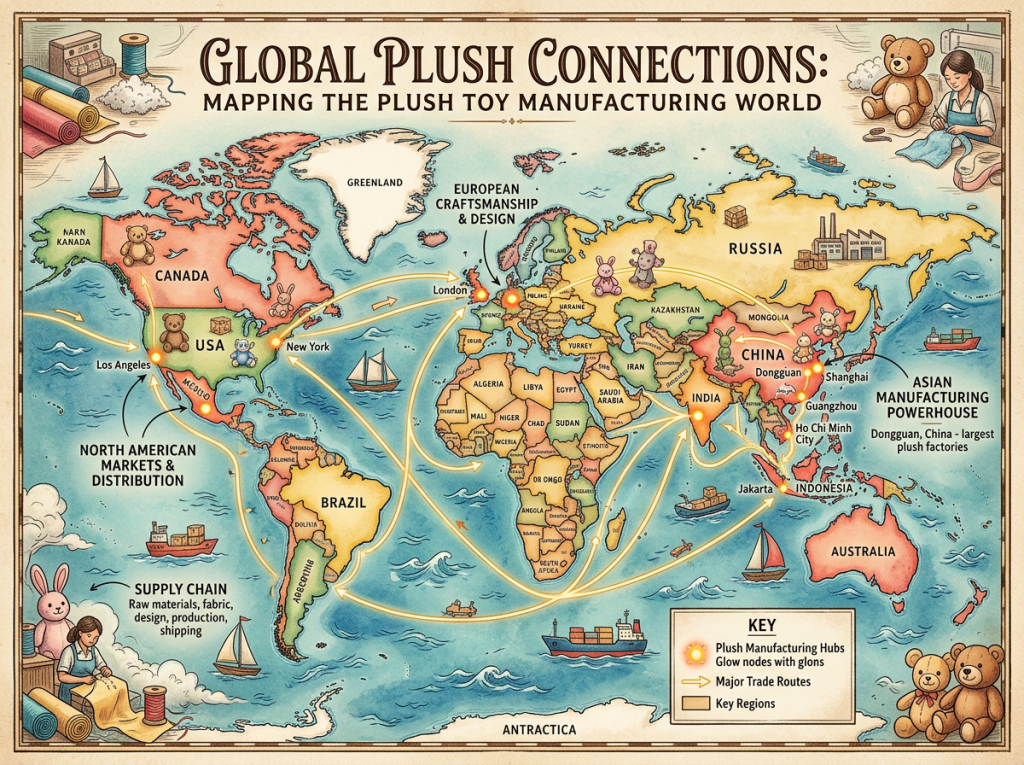
China: A Broad & Flexible Option for Custom Plush Production
China is often the first manufacturing country buyers encounter when researching custom plush toy manufacturers, and there is a practical reason for that.
Its major advantage is not simply price. It is the depth of the manufacturing ecosystem.
A buyer might be on the hunt for a certain fabric, some dope embroidered details, a sick printed pattern, a cool plastic accessory, custom packaging, tiny clothing, unique stuffing, or a wild construction technique. A solid manufacturing cluster can totally make it easier to get those requirements on point.
CustomPlushMaker, for real, talks about its factory in China offering all the vibes with OEM/ODM plush manufacturing, embroidery, heat-transfer printing, silk-screen printing, and a bunch of other customization options. It says they’ve got a 100-piece minimum order and can produce a ton each month.
Advantages of China
China can be particularly attractive when you need:
- Complex character designs
- Multiple fabric types
- Embroidery and printed details
- Customized accessories
- Larger production runs
- Repeat manufacturing
- Product development support
- Competitive factory pricing
- International shipping experience
- A broad choice of suppliers
Potential disadvantages
The disadvantages are equally important to understand.
International buyers need to account for:
- Shipping time
- Import procedures
- Inspection requirements
- Communication differences
- Trade-policy changes
- Factory verification
- Payment terms
- Quality-control costs
Another important point is that China is not one factory market.
Two factories in the same country can have completely different equipment, pattern-making expertise, quality-control procedures, minimum order quantities, lead times and communication standards.
Therefore, Made In China is not enough information to evaluate a plush supplier.
Vietnam: An Important Alternative for Supply-Chain Diversification
Vietnam has become increasingly relevant to companies looking to diversify manufacturing beyond a single country.
Its broader textile and garment manufacturing ecosystem provides a strong foundation for soft-product production, while its export manufacturing industry continues to develop.
For some brands, the strategic value of Vietnam is less about finding the absolute lowest production cost and more about creating a second sourcing option.
Vietnam may make sense for:
- Established brands
- Mid-volume production
- Private-label products
- Textile-heavy designs
- Companies pursuing China+1 sourcing
- Brands that want greater geographic diversification
Potential limitations
Compared with China’s enormous manufacturing ecosystem, Vietnam generally offers a smaller supplier base and less breadth of specialized component sourcing.
That does not make Vietnam inferior.
It simply means that a highly complicated product requiring many different components may be easier to coordinate through a deeply integrated supply chain.
India: Growing Opportunity for Plush and Soft Products
India has a strong textile and craft manufacturing tradition and an expanding organized toy industry.
For international buyers, India can offer an interesting alternative when textile skills, developing manufacturing capabilities, product differentiation, or supply diversification are priorities.
Potential advantages
- Strong textile expertise
- Large manufacturing workforce
- Growing toy manufacturing sector
- Potential for differentiated craftsmanship
- Increasing interest in export-oriented production
- Useful diversification option
Potential limitations
India’s plush-specific supplier ecosystem is not as extensive as China’s, and individual manufacturers can vary considerably in their production systems and international-market experience.
That makes supplier qualification especially important.
Indonesia: An Established Manufacturing Option
Indonesia should not be ignored when researching global plush manufacturing.
The country has established textile and soft-product manufacturing capabilities and international export experience.
For certain large production programs, an experienced Indonesian manufacturer can be a practical option.
The main consideration is supplier depth.
China gives buyers a very large pool of factories and supporting suppliers. Indonesia can offer excellent manufacturers, but the market is comparatively more concentrated.
That means buyers may need to spend more time identifying a manufacturer that matches a highly specific design or production requirement.
United States: When Higher Unit Cost Can Still Make Sense
U.S. manufacturing is often dismissed because the factory price may be higher.
That can be a mistake.
A U.S. manufacturer may provide advantages that are not reflected in the initial unit quotation.
These can include:
- Easier communication
- Domestic shipping
- Faster issue resolution
- Easier factory visits
- Simpler project coordination
- Potentially smaller production runs
- Made-in-USA positioning
- Easier domestic quality inspection
U.S. manufacturers also serve specialized markets such as mascots, promotional products, entertainment merchandise, events and oversized plush.
For example, U.S.-based manufacturers market custom plush production for brands and large mascot projects rather than competing purely on commodity-scale manufacturing.
When should you consider a U.S. manufacturer?
A domestic manufacturer may be worth considering when:
- You only need a small quantity
- Your deadline is tight
- You need frequent communication
- Your product is unusually large
- Domestic manufacturing is part of your brand story
- You’re supplying a university or sports organization
- You need rapid local replenishment
The important lesson is:
Unit price is not the same as total project cost.
Mexico: A Proximity Advantage for North American Buyers
Mexico is another location worth investigating, particularly for U.S. businesses that value geographic proximity.
Potential advantages include:
- Shorter physical distance to U.S. customers
- Potentially simpler regional logistics
- Easier travel for factory visits
- Similar time-zone coverage for many U.S. businesses
- North American supply-chain diversification
The limitation is that Mexico does not have the same breadth of plush-specific manufacturing infrastructure as China’s major production clusters.
So it may be particularly interesting for buyers whose priority is proximity rather than maximum supplier choice.
Europe and the UK: Product Development Can Be More Important Than Factory Location
European and UK plush suppliers illustrate an important point: the company selling or developing the product does not always manufacture the product domestically.
Some European businesses combine local product development, communication, licensing and quality management with manufacturing relationships in Asia.
That can be a very effective model.
For Example
UK-based plush businesses may manage product development and customer relationships locally while manufacturing through overseas partners.
This approach can be particularly attractive for:
- Museums
- Heritage organizations
- Premium gift companies
- Licensed products
- European brands
- Collectibles
The best supplier relationship is sometimes a development partner plus an overseas production facility, rather than a factory physically located in the buyer’s country.
How Different Customers Should Choose a Custom Plush Toy Manufacturer
This is where supplier selection becomes much more useful.
The right factory depends heavily on what you are trying to accomplish.
Kickstarter Creators
Kickstarter creators usually face a unique combination of uncertainty and opportunity.
You may not know whether you will sell 100, 500, 2,000 or 10,000 units.
Your first priority should therefore not be maximum factory capacity.
Look for:
- Reasonable MOQ
- Affordable sampling
- Multiple prototype revisions
- Accurate character reproduction
- Transparent production timelines
- Ability to scale after the campaign
- Quality control
- Packaging options
- Clear communication
A factory quoting a very low unit price at 10,000 units may be less useful to a creator who needs 300 finished units.
Artists and Illustrators
Artists often care more about visual accuracy than production scale.
Your design may have:
- Unusual proportions
- Tiny embroidery details
- Specific facial expressions
- Unique fabric requirements
- Asymmetrical features
- Unusual silhouettes
The factory needs to understand how to convert artwork into a three-dimensional sewn object.
Ask:
Who creates the pattern?
This can be one of the most important questions in the entire project.
A manufacturer may have excellent sewing workers but weak pattern development.
CustomPlushMaker states that its OEM/ODM workflow includes pattern making and development support, which is exactly the type of capability artists should evaluate.
Startups
Startups usually need flexibility, cost control and growth potential.
A good factory should ideally support the product through multiple stages:
Prototype → Small batch → Larger production → Repeat orders
Important questions include:
- What is the MOQ?
- Is the MOQ per design?
- What happens if the first order is successful?
- Can you reorder the same design?
- Will the factory retain the correct pattern?
- Can packaging be customized?
- Can production increase without a major quality drop?
Amazon Sellers
Amazon sellers should focus on landed cost, not factory price.
A simple calculation is:
Landed Cost = Product + Packaging + Testing + Inspection + Freight + Duties/Tariffs + Other Import Costs
A factory offering the lowest quoted unit price may not produce the lowest final cost.
Amazon sellers also need to think about:
- Product consistency
- Reorder reliability
- Pengemasan
- Barcodes
- Labeling
- Defect rates
- Inspection
- Safety compliance
- Inventory planning
For children’s products entering the U.S. market, compliance responsibilities can be significant. CPSC states that toys intended for children 12 and under generally require third-party testing and certification through a Children’s Product Certificate, subject to applicable rules and exemptions.
Private-Label Brands
Private-label brands need consistency more than a one-time prototype.
Your manufacturer should be able to maintain:
- The same colors
- Same proportions
- Same materials
- Same embroidery
- Same filling
- Same packaging
- Same labeling
- Consistent quality between production runs
Ask the manufacturer how it handles your master sample.
A good supplier should understand that the approved sample becomes a production reference. Not simply a sample to be forgotten after the first order.
Established Brands and Licensed Characters
Established brands have more at stake.
When producing recognizable intellectual property, buyers should evaluate:
- Confidentiality procedures
- IP protection
- Pattern ownership
- Production security
- Quality control
- Licensing requirements
- Factory references
- Subcontracting practices
- Capacity
- Compliance documentation
Don’t assume that a supplier’s statement that it has worked with large companies automatically proves that it can manage your IP safely.
Verify the process.
Ask:
- Who will have access to my artwork?
- Is production subcontracted?
- Who owns the production pattern?
- Can the factory display the product publicly?
- How is confidential artwork stored?
Large Retailers
Large retailers require a completely different level of manufacturing discipline.
The buyer may need:
- Factory audits
- Third-party testing
- Social-compliance documentation
- Quality-control records
- Production traceability
- Packaging compliance
- Capacity planning
- Consistent replenishment
- Strong logistics management
At this scale, a one-cent or five-cent difference in the factory quote may matter less than avoiding:
- Failed inspections
- Retailer compliance problems
- Late shipments
- Defective inventory
- Recalled products
A reliable factory can be more valuable than the cheapest factory.
Universities
Universities commonly need mascot plush products, alumni merchandise, graduation gifts, sports merchandise and event products.
They may not need extremely large production quantities.
Instead, they often value:
- Accurate branding
- Mascot reproduction
- Moderate MOQs
- Easy communication
- Good quality
- Reliable repeat ordering
- Domestic or relatively convenient shipping
That makes a U.S. or Canadian supplier potentially attractive—even when an overseas factory has a lower unit cost.
Sports Teams and Mascots
Sports merchandise is deadline-driven.
A mascot plush may need to arrive before:
- A new season
- A championship campaign
- Alumni weekend
- A major tournament
- A promotional event
- A merchandise launch
For those projects, production speed and shipping reliability can be more important than obtaining the absolute lowest price.
Large or unusual mascot designs also require manufacturers that understand how to build substantial three-dimensional plush forms.
Museums and Cultural Institutions
Museum stores often need products that are more specialized than conventional mass-market plush.
The design may be based on:
- Historical objects
- Animals
- Cultural figures
- Artwork
- Local icons
- Archaeological subjects
- Institutional mascots
Accuracy and storytelling matter.
A successful museum plush product may also require customized packaging, educational information, premium finishing or a design that works for both children and adult collectors.
This is a case where the manufacturer’s development expertise can be as important as its production capacity.
High-End Gift Shops
Gift shops generally sit between mass-market plush and luxury collectibles.
Their customers may expect:
- Attractive fabrics
- Clean embroidery
- High-quality stitching
- Refined facial details
- Beautiful packaging
- Strong tactile quality
For these buyers, the right factory is usually one that can deliver a higher-quality appearance without making the product financially impossible to retail.
Luxury and Premium Collectible Brands
Premium plush products should be evaluated differently from ordinary toys.
A luxury or collectible product may involve:
- Premium fabrics
- Limited editions
- Complex accessories
- Clothing
- Special embroidery
- Custom packaging
- Numbered editions
- Authentication cards
- Higher inspection standards
In this category, the cheapest manufacturer may be the wrong manufacturer.
The question becomes:
Can this factory consistently reproduce the exact finish that the brand promises its customers?
How to Choose a Factory for Products Sold in Different Markets
Your sales market also affects supplier selection.
Products sold in the United States
Consider:
- Cina
- Vietnam
- United States
- Mexico
- Other qualified suppliers
The key factors are landed cost, testing, import requirements, production scale and delivery timelines.
For children’s toys, U.S. federal requirements can include ASTM F963-based toy safety requirements and third-party testing/certification. CPSC identifies ASTM F963 as the mandatory toy safety standard framework and states that children’s toys intended primarily for children 12 and under require third-party testing and a CPC, subject to applicable requirements.
Products sold in Canada
Canadian buyers should evaluate their supplier against Canada’s Toys Regulations and related safety requirements.
Health Canada specifically highlights mechanical hazards, flammability and requirements affecting dolls, plush toys and soft toys.
Recent Canadian compliance work is also a useful reminder that imported plush products still need close attention to compliance: Health Canada’s 2024–2025 compliance-verification project tested 25 plush products and reported nine recalls.
Products sold in Europe
European-market buyers need to evaluate CE and applicable toy-safety requirements carefully.
The EU’s new Toy Safety Regulation, Regulation (EU) 2025/2509, establishes updated safety requirements and introduces a Digital Product Passport framework for toys. The regulation requires manufacturers to create a digital product passport before placing a toy on the market, subject to the regulation’s application dates and transitional provisions.
This makes early compliance planning increasingly important for brands targeting Europe.
Products sold in Asia
Asian buyers have the advantage of being geographically closer to major manufacturing hubs such as China, Vietnam, India and Indonesia.
However, product standards vary by destination country, so the correct factory should be selected based on the regulations of the market where the product will actually be sold.
Custom Plush Toy Safety: Don’t Leave Compliance Until the End
One of the most common sourcing mistakes is treating compliance as a final paperwork exercise.
It isn’t.
Compliance can affect:
- Fabric
- Dyes
- Filling
- Thread
- Plastic components
- Eyes
- Noses
- Magnets
- Accessories
- Pengemasan
- Labels
- Age grading
- Product construction
In the United States, CPSC explains that applicable toy requirements include ASTM F963 and other children’s product safety rules. Its ASTM chart specifically identifies requirements relevant to stuffing materials and other components of certain toys.
Canada also has specific requirements for plush products. Health Canada notes, for example, that stuffing for dolls, plush toys and soft toys must be free of hard and sharp matter, while certain eyes and noses must meet mechanical attachment requirements.
Ask your manufacturer:
- Which markets have you supplied?
- Which testing laboratories do you normally work with?
- Can you provide relevant test reports?
- Can you support the documentation required by my importer?
- What happens if I change the fabric or accessory?
- Does a material change require retesting?
- Who is responsible for final certification?
Never assume that a generic CE, ASTM, or CPSIA statement automatically proves compliance for your exact product.
Frequently Asked Questions
What is the best country for custom plush toy manufacturers?
There is not just one best country. China is very flexible because it has a lot of suppliers and makes a lot of things. However sellers from Vietnam, India, Indonesia, the US, Mexico, Canada and Europe may be better for you. It is totally based on the no. of products you need, how complicated the product is, how quickly you need it and your target market.
What is the minimum order quantity for custom plush toys?
MOQ vary by manufacturer, design and production requirements. Some factories advertise MOQs around 100 pieces, while other requires larger quantities. CustomPlushMaker currently advertises a 100 pieces MOQ for its custom plush manufacturing services.
Can I order custom plush toys in small quantities?
Yes. Some manufacturers offers low MOQ production, although small orders generally have higher per unit costs because factory’s sampling, pattern, setup and labor expenses are spread over fewer products.
How long does it take to manufacture custom plush toys?
The timeline really hinges on how complex the product is, how many prototypes we’re talking about, where we’re getting materials from, the whole approval vibe, order quantity, and the factory schedule. Always try to request separate estimates for sampling and bulk production.
Is China good for custom plush toy manufacturers?
Yes. China has a broad and mature manufacturing ecosystem for customized soft products. It works best for complicated designs, big orders, embroidery, accessories, packaging and making the same thing over and over again. But customers should still look at each factory separately instead of thinking that all suppliers can do the same things.
Are custom plush toys safe for children?
They can be, but the finished product must meet the requirements that apply to its intended market and use. In the United States, children’s toys intended primarily for children 12 and under generally require third-party testing and certification under applicable children’s product safety rules.
What safety standards apply to plush toys in the United States?
Applicable requirements can include ASTM F963 and other federal children’s product safety rules. CPSC states that ASTM F963 is the mandatory toy safety standard framework incorporated into federal regulation, with the current accepted version and applicable provisions governing products within scope.
Do plush toys sold in Canada have safety requirements?
Yes. Canada’s Toys Regulations include requirements for mechanical hazards, flammability and other safety risks affecting dolls, plush toys and soft toys. Health Canada has also conducted specific compliance-verification projects involving plush toys.
What should I send a custom plush manufacturer?
You can drop some artwork or sketches, dimensions, colors, reference pics, materials, accessories, packaging needs and how many you are looking for? Thanks! When you nail down the product details, it is way easier for manufacturers to give you spot on quotes.
Should I choose OEM or ODM manufacturing?
Choose OEM when you already have a developed design or specification. ODM can be more useful when you have an idea or rough concept and need the manufacturer’s design and development team to help create the final product.
How do I avoid poor-quality plush manufacturing?
Make sure to grab a physical sample, set up that master sample everyone agrees on, double check the materials, peep the production, clear up those tolerances, go over the testing needs and write down how to deal with any defects before you drop a big order.
Kesimpulan
Custom plush toy manufacturers are not just about grabbing the lowest possible price or going for the factory with the biggest production output.
It is all about nailing that perfect mix of design skills, minimum order quantities, quality, production power, compliance, communication vibes, logistics, and being reliable for the long haul.
Research the country. Then research the factory. Then research the economics of your complete project.
That approach gives creators, brands, retailers, organizations and collectors a much better chance of turning a plush concept into a successful finished product.